Much of the world was holding its breath on Tuesday, April 7 after President Trump wrote, “A whole civilization will die tonight, never to be brought back again.” For some people on that day, the feelings of personal stress went through the roof. Uncertain times like these are indeed a mental health issue.
Uncertain, but not necessarily unprecedented
Fortunately, cooler heads prevailed, but we have been living in an increasingly anxious world. These are uncertain and scary times, but are unfortunately not unprecedented.
The aftermath of the 9/11/2001 attacks were unprecedented. I remember the paranoia that was widespread in the weeks and months afterwards. I remember leaving my office in downtown Chicago that morning out of fear of further attacks there and calming down a fellow subway passenger who was going through a panic attack.
Other times in our recent history have felt like extreme times. Many people lost their homes and jobs in the wake of the 2008 economic crash. Fears of nuclear war were widely expressed in 80’s pop music and culture. Those old enough to remember 1968 were certainly bewildered by the assassinations of Martin Luther King Jr., the riots in Detroit, Washington D.C., Chicago, and other cities that followed, the assassination of presidential candidate Robert F. Kennedy, the violent crackdown on protestors outside the Chicago Democratic Convention, and other events. And those old enough to grow up in the earlier parts of the Cold War, and particularly the 1962 Cuban Missile Crisis also had to deal with emotional fallout at the same time they worried about nuclear fallout.
This is not to normalize such events. No matter what year we’re living in–1962, 1968, 1983, 2001, 2008 or 2026–the outcome of things is uncertain. We don’t know what the future will be like. Indeed, some people who have lived through many these crises might become complacent at the arrival of new crises. Having lived through these crises, their perspective might be helpful in some ways. But they might also make the mistake of minimizing the dangerous nature of the current crises.
Uncertain times and the modern mental health profession
Modern mental health has, in many ways, failed to address the mental health fallout from living in uncertain times. The evolution of the modern mental health profession is rooted in individualistic problem solving approaches. This is fine as long as the problem is solvable internally. But this isn’t always the case.
I chose “the social work route” towards becoming a therapist because of the profession’s “person in environment” perspective. Even here though, modern social workers in mental health also often fall short on this perspective. Social workers are generally more trained to think about the more immediate living environment as opposed to other factors that also affect one’s feeling of safety. When it comes to situations that come up during uncertain times like these, standard social work training isn’t always helpful.
It has not been unusual for my clients to raise current events as a mental health issue in session. Nor should it be unusual. Many of my clients are part of marginalized groups that are widely stereotyped or targeted (especially by right-wing media). Or they may fear for their own short-term or long-term safety due to developing economic or environmental issues.
Exploring your feelings about these uncertain times
So, I’ve established that us therapists need to do more to address feelings from the uncertain times we live in. But what can you do for yourself?
The first question it to ask how much you know about the issue. Ever since writing about clickbait nearly three years ago, it seems that clickbait on the internet has only gotten worse. Just look at the video feed of YouTube or other social media apps . You will find no shortage of alternative realities being offered to you for your consumption. There are many videos insinuating that China or Russia are on the verge of collapse, and oddly enough, they are still around. I see a lot of video garbage on both the left and right. I used to respect some of these channels but they’ve gotten more and more clickbait-y over the years. (TYT I’m looking at you.) So the first piece of advice is to do some fact-checking on the things you find.
Next is to ask what are the possible outcomes of this issue? We are wired to consider the worst possible outcomes, because that is how our brain tries to protect us. But the worst possible outcomes aren’t the only possibilities, and often they aren’t even the most likely.
You should also pay attention to not only the quality of what you read, but also the quantity. I have found that there is a balance between being informed and being oversaturated with information. It’s fair to ask the following questions with each new article or video that comes across your feed: Will this piece information add significantly to your understanding and knowledge of an issue? Will it change the way that you address the issue? Does what you read motivate you to do something about the issue? Or do you find yourself sinking more into depression? Staying on top of what’s going on is important. But it shouldn’t consume your time so much that it inhibits your ability to live life.
What to do about these uncertain times
You feel the anxiety you feel because there is a certain danger that your brain has detected. Your brain wants to resolve the issue somehow. Fifty thousand years ago, the threat might have been the roar of a saber-toothed tiger in the distance, and the resolution might have been to retreat to a cave or climb a tree. In our modern day life, the sense of threat and resolution may be more complicated.
We aren’t going to defuse nuclear weapons on our own. We won’t single-handedly shut down the industries contributing to climate change and other types of pollution. But sometimes feeling like we’ve done our part can help. I remember as a reporter for my high school paper asking a nuclear disarmament activist if delving so deeply into these issues made her more fearful. She surprised me by saying that she felt less fearful because she felt like change was more possible than before. This might not necessarily work for everyone, but it does work for some people.
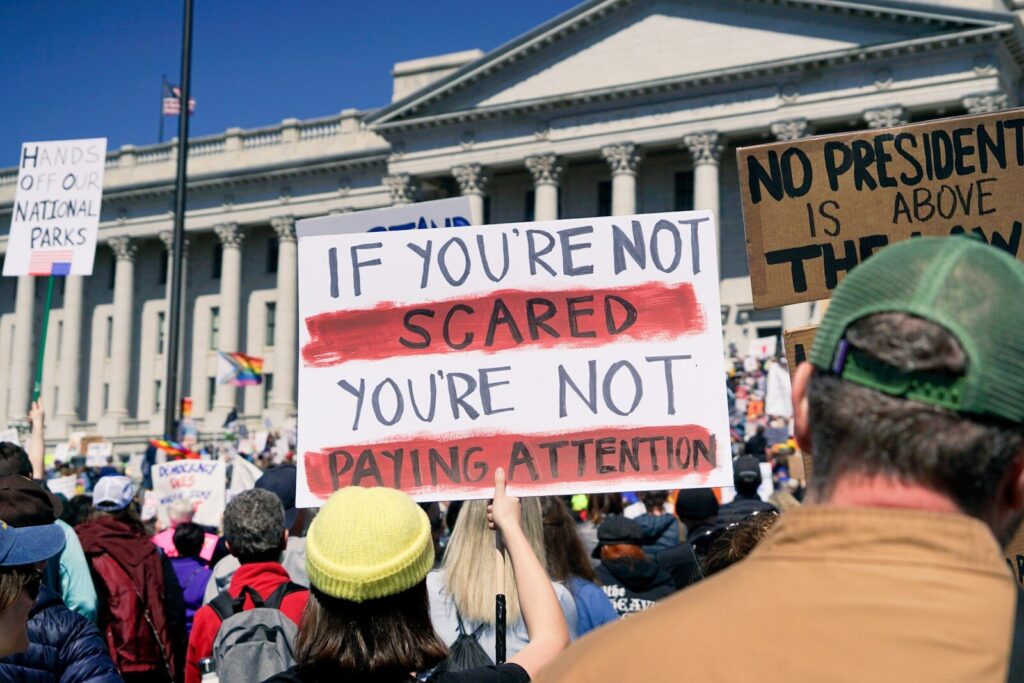
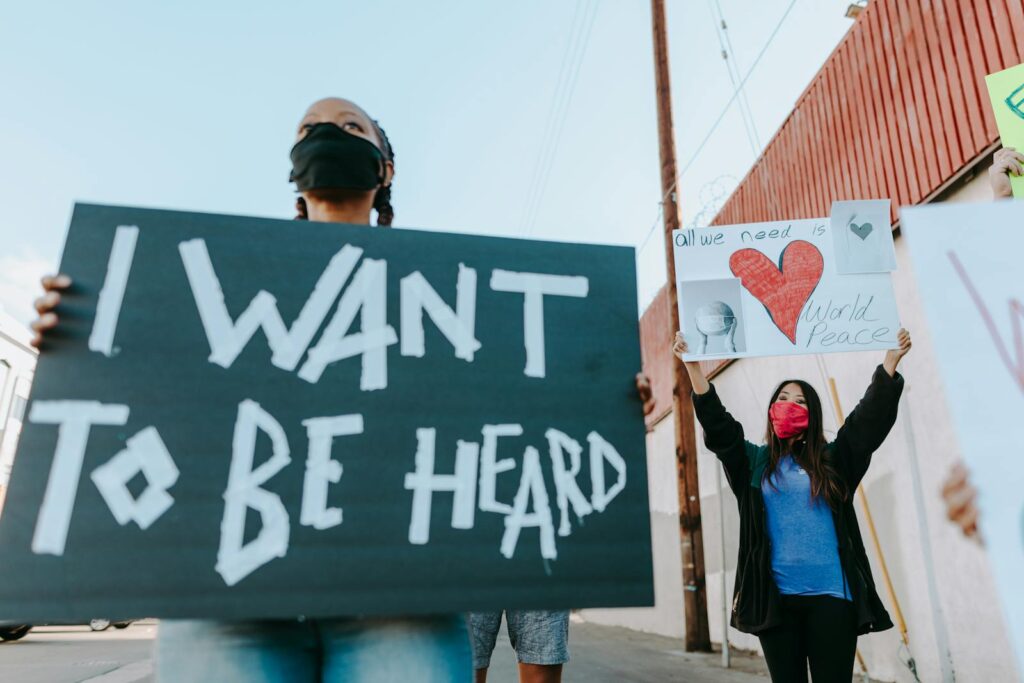
Chances are, you don’t need to dive in so deeply in order to feel better about the issue. Maybe a letter or email to your local representatives or to your local newspaper can help you feel like you’re doing something about the issue. There is debate about how worthwhile the No Kings protests have been over the past year. But many people have felt that being visible and being with others at events like these has been very helpful.
Talk about it
I think that not being alone with your feelings and fears is important. Sharing your feelings with others can be helpful. It’s important that will validate your feelings and also not catastrophize things to such a degree that you feel worse.
But there is certainly room to talk about these things with your therapist. I consider these issues very important and am willing to prioritize them in therapy. Some may tell you that if something bothers you that you shouldn’t think about it. Or that you should “think more positively.” That’s not helpful. As for me, I’m always happy as a therapist to explore those feelings with my clients and work with you to find the best ways to respond to them.